Hello,
I would like to use capella by describing a complex system with several models by this way described bellow.
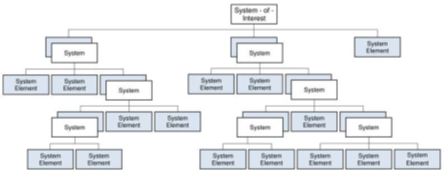
At first, according ISO 15288, a system can be decomposed with sub-systems and system element, each sub-system can be also decomposed into sub-systems and system element.
At the end of all decomposition we’ve only system element ; system element means that it won’t be decomposed after and represent what is expected
On my complex System Of Interest (SOS), I described my system with Operational Analysis, System Analysis and Logical Architecture layers.
At the SOS Logical Layer I can modelise different Logical Components (LC1, LC2, LC3, LC4….) each one represent my sub-systems and the function allocated on.
For Each sub-system, I done a model (by using System to Subsystem transition vertical to SA), so for exemple LC2 have is own model with :
- At System Analysis, a black-box view is inherited from SOS model / Logical Layer by the use of System to subs-System transition : context diagram, functions…
- At Logical Level, I modelised a white-box view with function and Logical Components : LC2 is decomposed into LC21, LC22, LC23
- Also (in the future) to add variation point related to the internal design variant of LC2
Recursively, I can use the same approach to modelise LC21 with a new model
At the end I’ve different models, potentially with their own variation points.
I would like to know if their an automatic mechanism in Capella to rebuilt a new detailed model :
- By starting from the SOS model
- To replace the black-box LC component LC1, LC2, LC3… by theirs white-box models (or in addition to chose a white-box model in case of several alternaltive white-bow models)
- In order to have a SOS detailed Logical Architecture Layer with LC11, LC12, LC211, LC212, LC213, LC221, LC222… and the functions allocated onto this detailed Logical Component which represent all my SOS System Elements
After that I want on thiw new / large model to work on Physical Layer, to define where to deployed all detailed Logical Element on Physical nodes
So I’m looking for tips/recommndations or alternative ways and links to documents and demo
Thanks